5 Essential Calculators for Financial Planning: Loans, Discounts, Percentages & Health
All Quick Tool Team
March 25, 2026Why Accurate Calculations Drive Better Financial Decisions
The average person makes 35,000 decisions per day, but only 5% involve calculations. Yet the decisions that do require math often carry the highest financial impact:
- Loan mistakes: 1% higher interest rate over 30 years adds $60,000+ to a mortgage
- Discount confusion: "50% off then 20% off" is NOT the same as "70% off"—it's 60% off
- Tip miscalculation: Tipping wrong percentage at restaurants costs money unnecessarily
- Health tracking errors: Wrong BMI calculation leads to wrong fitness goals
- Tax planning failures: Percentage calculation mistakes cost thousands in tax time
This is why free, accurate calculators exist. They eliminate mental math errors and let you focus on decision quality, not calculation accuracy.
Calculator #1: Loan EMI Calculator (Your Biggest Financial Tool)
What is EMI and Why It Matters
EMI (Equated Monthly Installment) is the fixed amount you pay monthly on a loan. It includes both principal (amount borrowed) and interest (cost of borrowing).
Real-World EMI Scenarios
Home Mortgage
- Loan amount: $300,000 | Interest: 6.5% | Duration: 30 years
- Monthly EMI: $1,896.20
- Total paid: $682,632 (interest = $382,632)
What a 1% rate increase costs: At 7.5% rate, monthly EMI = $2,098.43 = $72,804 MORE over 30 years
Car Loan
- Loan amount: $25,000 | Interest: 4.2% | Duration: 5 years
- Monthly EMI: $458.53
- Total interest: $2,511.80
Personal Loan
- Loan amount: $10,000 | Interest: 8.5% | Duration: 3 years
- Monthly EMI: $312.17
- Total interest: $1,238.12
How to Use EMI Calculator Effectively
- Calculate before applying: Know your exact monthly commitment before taking the loan
- Compare lenders: Small APR differences add up; compare EMI across 3-5 lenders
- Evaluate affordability: Your EMI shouldn't exceed 30% of monthly income
- Plan for prepayment: Calculate interest saved if you can pay extra principal
- Understand interest vs. principal: Early payments mostly cover interest; later payments cover principal
Calculator #2: Discount Calculator (The Retail Reality)
Why Discounts Are Confusing
Sign: "50% Off Everything! Plus an Additional 20% Off!"
What most people think: 50% + 20% = 70% off
What actually happens:
- Original price: $100
- After 50% off: $100 - $50 = $50
- Additional 20% off $50: $50 - $10 = $40
- Actual discount: 60% off, not 70% = You save $10 per item
Real-World Discount Scenarios
Black Friday Shopping
- Shirt: Originally $50, marked 40% off = $30
- Pants: Originally $80, marked 35% off = $52
- Shoes: Originally $120, marked 50% off = $60
- Total: $142 (instead of $250)
Buy 2 Get 1 Free
- Item price: $30 each
- You pay: $30 + $30 = $60
- You get: 3 items
- Effective price per item: $20 (33% savings)
Calculator #3: Percentage Calculator (The Universal Solver)
Why Percentages Are Everywhere in Finance
- Tip calculation: 15%, 18%, 20% of restaurant bill
- Tax calculation: Sales tax, VAT, GST on purchases
- Grade calculation: "I got 87/100. What's my percentage?"
- Investment returns: "My stock returned 12% this year"
- Salary increase: "I got a 5% raise. How much is that?"
- Weight loss: "I've lost 12 pounds. What percentage of my weight is that?"
Real-World Percentage Scenarios
Restaurant Tipping
- Bill: $58.75
- 15% tip: $8.81 | 18% tip: $10.58 | 20% tip: $11.75
Sales Tax
- Item: $45.99 | Sales tax (9.5%): $4.37 | Total: $50.36
Salary Increase
- Current salary: $50,000 | Raise (5%): $2,500 | New salary: $52,500
Three Types of Percentage Problems
Type 1: What is X% of Y?
- "What is 18% of $58.75?" (Tipping problem)
Type 2: What percentage is X of Y?
- "What percentage is 45 out of 200?" (Test score problem)
Type 3: If Y is X% increase/decrease, what was the original?
- "My salary is $52,500 after a 5% increase. What was my original salary?"
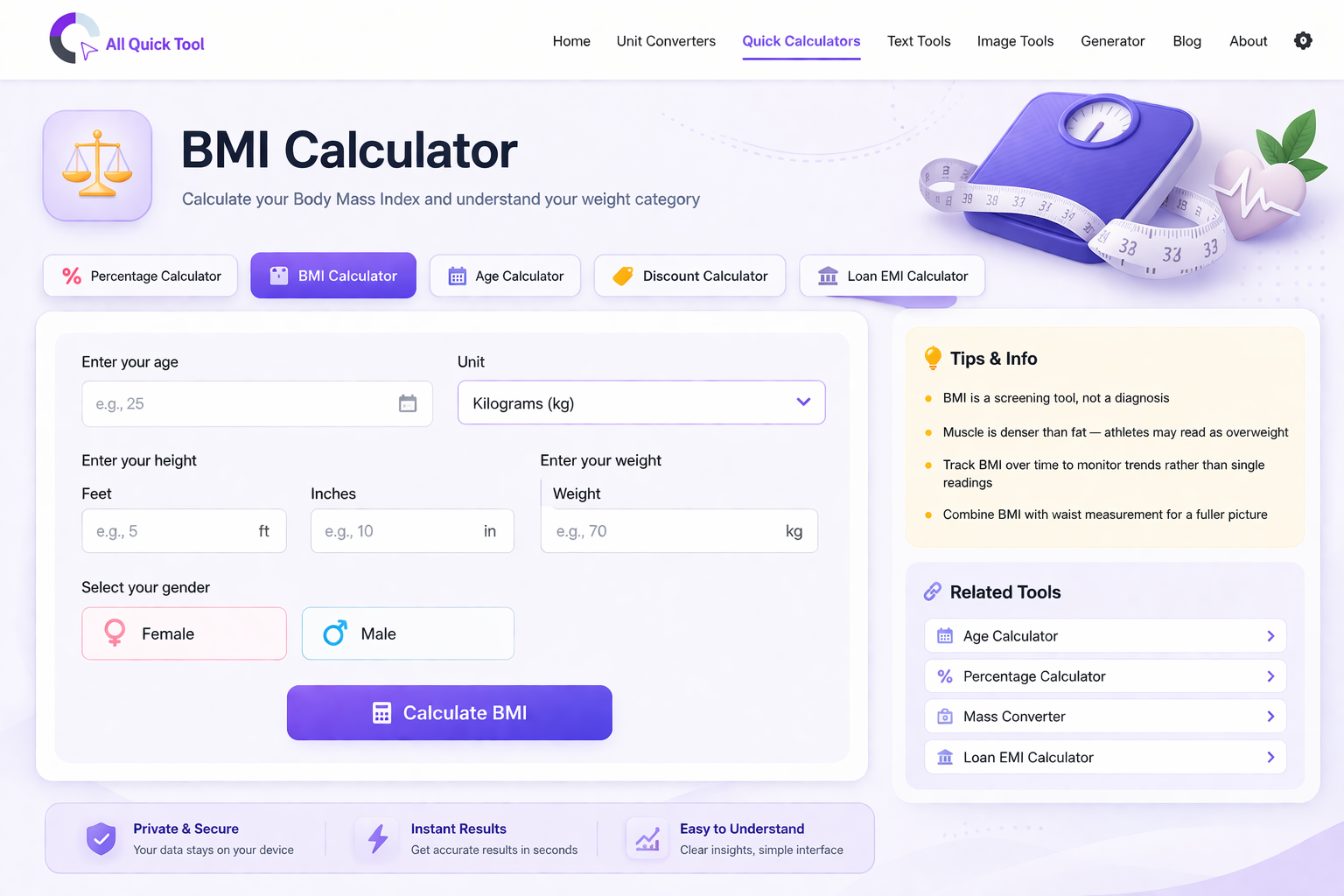
Calculator #4: BMI Calculator (Health Baseline)
What BMI Measures
BMI (Body Mass Index) = Weight in kg / (Height in m)²
Important caveat: BMI is a screening tool, not a diagnostic measure. It doesn't account for muscle mass, bone density, athletic build, or age. Always consult healthcare professionals for personalized health advice.
BMI Categories
- Below 18.5: Underweight (nutrient deficiency risk)
- 18.5 - 24.9: Normal weight (lowest risk)
- 25 - 29.9: Overweight (increased chronic disease risk)
- 30+: Obese (significantly increased health risk)
Real-World BMI Scenarios
Example 1
- Height: 5'9" (1.75m) | Weight: 180 lbs (82 kg)
- BMI: 82 / (1.75²) = 26.8 → Overweight
Example 2
- Height: 5'4" (1.63m) | Weight: 120 lbs (54 kg)
- BMI: 54 / (1.63²) = 20.3 → Normal weight
BMI Limitations
- Doesn't account for muscle: Athletes may have "overweight" BMI despite being fit
- Doesn't account for age: BMI targets differ for seniors and children
- Doesn't account for ethnicity: Some populations have different health risk profiles
- Doesn't measure body composition: 30% body fat vs. 15% body fat aren't reflected in BMI
Calculator #5: Age Calculator (Multiple Uses)
Why Age Precision Matters
- Legal age verification: "Am I old enough for this?"
- Medical contexts: Doctors need exact age for dosing and recommendations
- Government applications: Passports, permits, registrations require exact age
- Life planning: Calculating retirement eligibility, college ages, etc.
Real-World Age Calculation Scenarios
Determining Exact Age
- Birth date: March 15, 1995 | Today: May 17, 2026
- Age: 31 years, 2 months, 2 days
Days Until Birthday
- Birthday: December 25 | Days remaining: 222 days (if today is May 17)
Age Eligibility
- Requirement: Must be 18+ to vote
- Birth date: June 3, 2008 | Today (May 17, 2026): Age 17 (eligible in 17 days)
Combining Multiple Calculators for Financial Planning
Complete Scenario: New Car Purchase
- Step 1: Discount Calculator → Car $28,000 with 8% discount = $25,760
- Step 2: Percentage Calculator → Sales tax 7.5% on $25,760 = $1,932 → Total = $27,692
- Step 3: EMI Calculator → Finance $22,000 at 4.5% for 5 years = $415/month
- Step 4: Affordability Check → Monthly EMI of $415 = 12% of $3,500 income ✓
Financial Planning Best Practices
- Always calculate before committing: Loans, purchases, and investments deserve calculation time
- Compare options side-by-side: 1% difference doesn't sound like much until you calculate it
- Factor in total cost, not just monthly payment: A lower monthly EMI might mean paying interest longer
- Build in buffer for uncertainty: If EMI should be 30% of income max, aim for 25%
- Use multiple tools together: Discount → tax → EMI for complete financial clarity
Integration with Your Broader Toolkit
Combine financial calculators with other tools for complete productivity:
- Calculate percentages → Track with text tools for budget spreadsheets
- Compare loan EMI → Convert currency/units for international purchases
- Analyze discounts → Generate QR codes for sharing shopping deals
Explore more about unit conversions for international shopping and quick calculator tools for other financial scenarios.
Conclusion
Smart financial planning starts with accurate calculations. Whether you're comparing loans, calculating tips, tracking health metrics, or analyzing discounts, these five calculators eliminate guesswork and let you make confident decisions backed by real numbers.
Start using these free financial calculators today. Your wallet will thank you. No signup required, completely free, and 100% browser-based—your financial data never leaves your device.
Discover More Tools & Guides
Explore all of All Quick Tool's resources and tutorials to boost your productivity.
Master Unit Conversions: Complete Guide to Length, Weight, Temperature & More
Complete unit conversion guide for length, weight, temperature, volume, and more. Free conversion tools for students, travelers, engineers, chefs, and anyone working with measurements. No formulas to memorize.
Maximize Productivity with Text Tools: 5 Essential Tips for Content Creators, Students & Writers
Master 5 essential text tools to streamline your workflow. Learn word counting, text formatting, duplicate removal, and content optimization techniques for students, bloggers, and professionals.
BMI Calculator: What Your Number Really Means, What It Misses & What to Do About It
Calculate your BMI and understand what it actually means for your health. This guide explains BMI categories, their limitations, what BMI misses (muscle mass, ethnicity, age), and the next steps for improving your health metrics. Includes free BMI calculator.