BMI Calculator: What Your Number Really Means, What It Misses & What to Do About It
All Quick Tool Team
April 30, 2026You Just Calculated Your BMI. Now What?
You entered your height and weight into a BMI calculator, got a number, and now you're staring at a category label—"Overweight" or "Normal" or "Obese"—trying to figure out what it actually means for your health. Does it mean you're unhealthy? Do you need to see a doctor? Is it accurate?
This guide answers all of that. BMI (Body Mass Index) is one of the most used and most misunderstood health metrics in existence. It takes 5 seconds to calculate and can take 20 minutes to properly interpret. We're going to do that interpretation properly.
How to Calculate Your BMI (And What the Formula Actually Means)
BMI is calculated as: weight (kg) ÷ height² (m²)
For imperial units: weight (lbs) × 703 ÷ height² (inches²)
Example: A person who is 5'9" (175cm) and weighs 180 lbs (81.6 kg):
- Height in meters: 1.75m
- Height squared: 1.75 × 1.75 = 3.0625
- BMI = 81.6 ÷ 3.0625 = 26.6 (Overweight category)
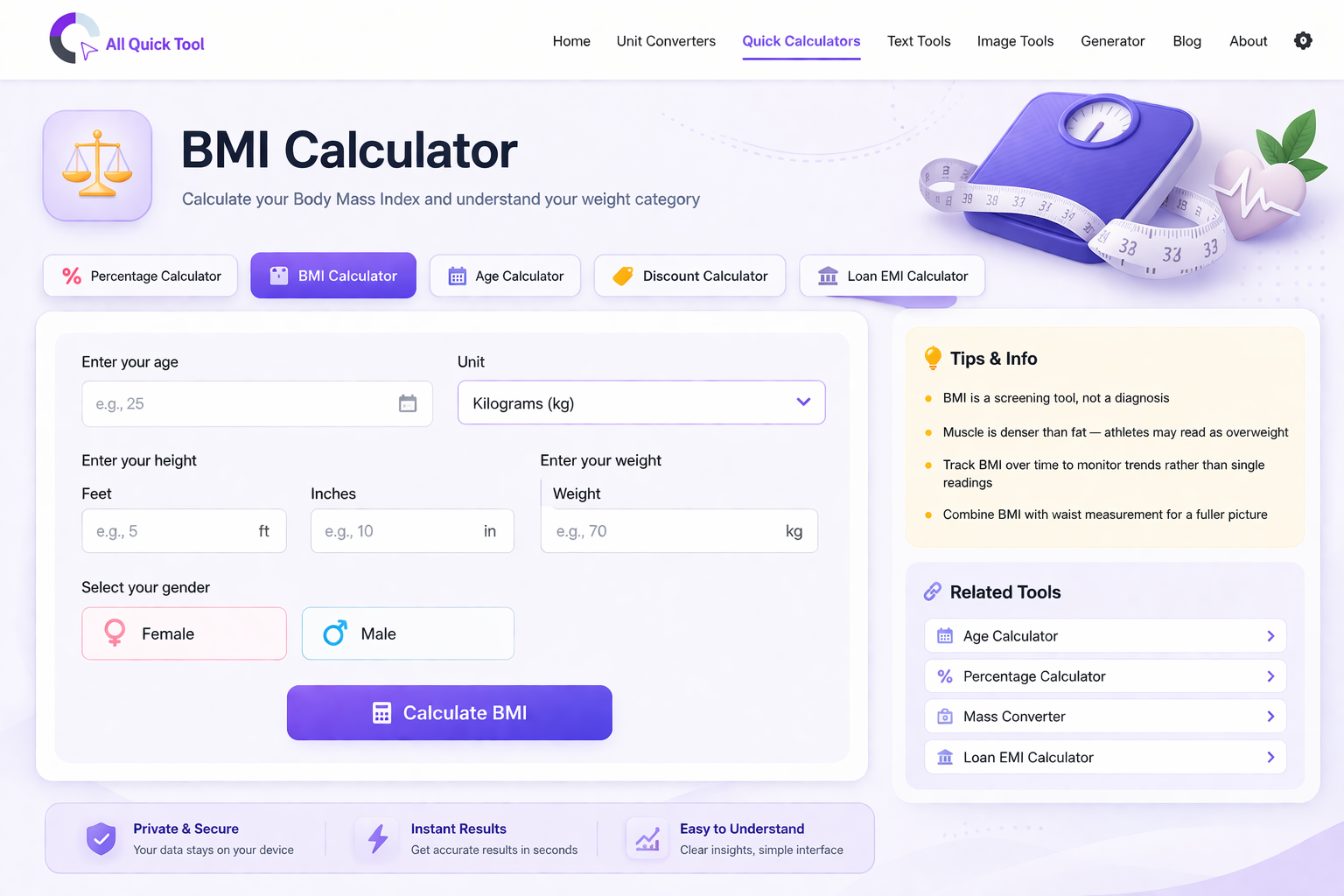
Skip the math. Use our free BMI calculator to get your result instantly—no formula memorization needed.
BMI Categories: What Each Range Means
The World Health Organization (WHO) defines BMI categories as follows:
- Below 18.5 — Underweight: May indicate nutritional deficiency, eating disorders, or other underlying health conditions. Underweight individuals have increased risk of osteoporosis, immune deficiency, and fertility issues. Consult a doctor before making changes.
- 18.5 to 24.9 — Normal Weight: Associated with the lowest risk of weight-related health conditions based on population studies. This is the target range for most adults. Note: being in this range doesn't mean you're perfectly healthy—other factors matter too.
- 25.0 to 29.9 — Overweight: Associated with increased (not high) risk of type 2 diabetes, hypertension, and cardiovascular disease. Many people in this range are metabolically healthy. Context matters greatly—see limitations section below.
- 30.0 to 34.9 — Obese Class I: Moderate increase in health risks. Losing 5-10% of body weight typically produces significant metabolic improvements even without reaching the Normal range.
- 35.0 to 39.9 — Obese Class II: Severe increase in health risks. Medical supervision recommended for any weight loss program.
- 40.0 and above — Obese Class III: Very severe increase in health risks. Associated with significantly higher risk of comorbidities including sleep apnea, type 2 diabetes, heart disease, and some cancers.
BMI by Age Group: How Normal Ranges Shift
Children and Teenagers (2-19 years)
For those under 20, adult BMI categories don't apply. Children's BMI (called BMI-for-age) is compared to growth charts and expressed as a percentile:
- Underweight: Below 5th percentile
- Healthy weight: 5th-85th percentile
- Overweight: 85th-95th percentile
- Obese: At or above 95th percentile
Always consult a pediatrician to interpret children's BMI—they account for age, sex, and growth trajectory.
Adults Over 65
Research suggests that slightly higher BMI (25-27) may be protective in older adults, reducing risk of fractures from falls and providing metabolic reserves during illness. The standard "overweight" label may be misleading for seniors—discuss with your physician.
The Most Important Section: What BMI Gets Wrong
BMI was developed in the 1830s by Belgian mathematician Adolphe Quetelet as a population-level statistical tool. It was never designed to diagnose individual health. Here's what it misses:
1. Muscle Mass
Muscle is denser than fat. A 5'10" athlete with 15% body fat and significant muscle mass might have a BMI of 27 (technically "Overweight")—while a sedentary person of the same height with 35% body fat might have a BMI of 25 (technically "Normal Weight"). The athlete is healthier by every measurable metabolic marker, but BMI classifies them as less healthy.
Famous example: LeBron James (6'9", ~250 lbs) has a BMI of ~27.5 (Overweight). He is objectively not overweight by any clinical measure.
2. Fat Distribution (Where You Carry Fat)
Visceral fat (fat around organs in the abdominal cavity) is far more dangerous than subcutaneous fat (fat under the skin). Two people with identical BMIs can have very different health risks depending on whether they carry fat in their midsection or hips/thighs. Waist circumference is a better predictor of cardiovascular risk than BMI for this reason:
- Higher risk waist: Men over 40 inches (102cm), Women over 35 inches (88cm)
3. Ethnicity and Race
The WHO cut-off values were developed from predominantly European and North American populations. Research shows that South Asian, East Asian, and Southeast Asian populations develop health risks at lower BMI values. The WHO has acknowledged this and published adjusted cut-offs for Asian populations:
- South Asian / East Asian populations: "Overweight" threshold may be 23 (not 25); "Obese" threshold may be 27.5 (not 30)
4. Sex Differences
Women naturally have higher essential body fat than men (10-13% for women vs. 2-5% for men). Despite this, the same BMI thresholds are applied to both sexes, which may not reflect health equivalence accurately.
5. What BMI Tells You Nothing About
- Cardiovascular fitness (VO2 max)
- Blood pressure and cholesterol levels
- Blood glucose and insulin sensitivity
- Bone density
- Mental health
- Whether you exercise regularly
- Diet quality
Better Metrics to Use Alongside BMI
Waist-to-Height Ratio (WHtR)
Research suggests waist-to-height ratio is a better predictor of cardiovascular risk than BMI. Target: waist circumference less than 50% of your height.
- Example: If you're 5'8" (172cm), ideal waist ≤ 86cm (34 inches)
Body Fat Percentage
Healthy ranges:
- Men: Essential fat 2-5%, Athletes 6-13%, Fitness 14-17%, Average 18-24%, Obese 25%+
- Women: Essential fat 10-13%, Athletes 14-20%, Fitness 21-24%, Average 25-31%, Obese 32%+
How to Improve Your BMI (Without Crash Dieting)
If You're Overweight (BMI 25-29.9)
A 5-10% body weight reduction produces significant metabolic benefits:
- Losing just 5% of body weight (10 lbs for a 200 lb person) can reduce blood pressure by 5 mmHg, fasting blood glucose by 5-10%, and triglycerides by 10-15%
- You don't need to reach "Normal" BMI to see health improvements—progress matters more than reaching a number
Sustainable Approach
- Calorie awareness: 500 calorie deficit per day = ~1 lb per week weight loss. This is the clinically recommended rate (slow enough to preserve muscle mass).
- Protein priority: Higher protein intake (1.6-2.2g per kg body weight) during weight loss preserves muscle mass, preventing BMI from improving while body composition worsens.
- Resistance training: Building muscle simultaneously burns fat and improves metabolic rate—the BMI may not change dramatically but body composition and health markers improve significantly.
- Tracking tools: Use our calculators to track calories, body weight, and percentage changes in health metrics over time.
When to See a Doctor
You should consult a healthcare provider if:
- BMI is below 18.5 or above 30
- BMI has changed by more than 5 points in the last 6 months without intentional diet changes
- You're in the normal BMI range but have other risk factors (high waist circumference, family history, hypertension)
- You're planning a significant calorie restriction program
Conclusion
BMI is a useful screening tool—a quick check that prompts further investigation, not a diagnosis. Calculate it to understand your starting point, but pair it with waist circumference, fitness assessments, and actual metabolic bloodwork for a complete picture.
Use our free BMI and health calculators as part of a broader health tracking habit, and read our complete calculator guide for other health and financial metrics worth tracking regularly.
Discover More Tools & Guides
Explore all of All Quick Tool's resources and tutorials to boost your productivity.
5 Essential Calculators for Financial Planning: Loans, Discounts, Percentages & Health
Complete financial planning guide using 5 essential calculators: BMI calculator, loan EMI calculator, discount calculator, percentage calculator, and age calculator. Make smart financial decisions with accurate calculations.
Free Online Study Tools Every Student Needs in 2026: Word Counters, Calculators & More
Discover the best free online study tools for students in 2026. From word counters for essays to BMI calculators for health class, these browser-based tools require no signup and boost academic performance.
Master Unit Conversions: Complete Guide to Length, Weight, Temperature & More
Complete unit conversion guide for length, weight, temperature, volume, and more. Free conversion tools for students, travelers, engineers, chefs, and anyone working with measurements. No formulas to memorize.